.avif)
The New Media Retainer: How Independent Digital Agencies Secure Retention in the Age of AI Automation & Media Buying
.avif)
Having spent the majority of my career split between the supply and demand sides of programmatic media, I’ve watched the conversation and projects my teams are doing shift from traditional ad operations and execution to deep data architecture. Independent agencies are facing a massive structural crossroads in 2026. Many of you have always won on your agility, deep client relationships, and hands-on optimization. But if you look at the recent takeaways from Google Marketing Live (GML) 2026 conference and what is going on in the market this summer, the traditional playground has significantly pivoted.
Between conversational search in AI Mode (which has officially crossed 1 billion monthly users) and keywordless targeting through AI Max for Search, Google is absorbing the manual execution layer of paid media. When the platform handles the mechanics, the agency value needs to move entirely up the tech stack.
The new industry reality is simple: Strategy and data integrity are the only real differentiators left. To steer automated AI engines effectively, your agency has to feed them clean, self-describing data foundations. Even when clients demand full ownership of their tech stack, as an agency you must command the underlying naming and governance blueprints. If you are still letting media data sit fragmented across isolated, client-owned silos or vendor partners without a unified framework, you are giving away your competitive edge. For indie shops looking to protect their retention rates and scale mid-market clients, mastering the use of the Google Marketing Platform (GMP) ecosystem is no longer optional.
In multiple recent enterprise RFP we participated in at Dandelion this year, the brands are splitting their requirements cleanly in two: one request for managed media strategy, and a completely separate one for in particular Google’s technical infrastructure (most likely hunting for independent specialists over a holding company type “all in one” agency). In reviewing the technical requirements of multiple RFPs, I found it striking how few questions are now asked about campaign execution. Instead, the focus has shifted to data quality, taxonomy, measurement frameworks, overall business outcomes and who the actual team will be. The message from many recent RFPs is clear: clients want to own their tech seats, but they are still looking for independent shops to help guide them with the overall process.
Here are the 4 strategies your independent agency could be deploying right now to take back control.
1. Build a Centralized Data Command Center with Google’s Marketing Platform to start.
Stop letting your media data get trapped in platform specific or vendor silos. To act as technical data architects for your clients, you need a unified, independent repository by building a centralized data command center.
The anchor of this setup is Campaign Manager 360 (CM360). While independent tools like Display & Video 360 (DV360), The Trade Desk, Yahoo, and Amazon (and many more) can handle programmatic buying, CM360 will still act as your main ad server, giving you the unique ability to see across every single digital platform your clients use and coordinate closely with Google Analytics. For example it cross-measures impressions, clicks, and reach while completely de-duplicating cross-channel conversions to give you a single source of truth. By seamlessly linking CM360 with Google Analytics 4 (GA4) and Google Tag Manager (GTM), you can drastically streamline site and app tagging across all digital properties. For many mid tier clients Google Analytics is already a tool they are using making it an easy integration. While you can feed free GA4 data into Google's open-source Media Mix Modeling (MMM) tool Meridian, upgrading to Google Analytics 360 unlocks Meridian’s advanced forecasting tools directly inside the user interface without needing a large team of data scientists. This allows your agency to build a scalable command center that looks across the entire media mix, giving you the exact infrastructure needed for your clients.
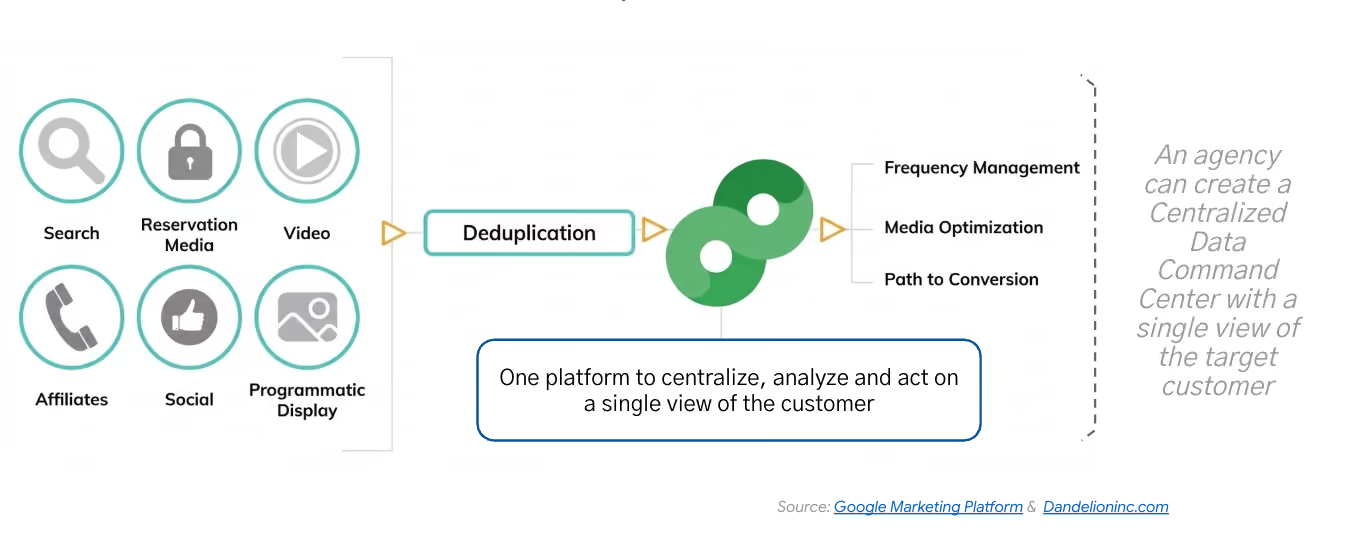
One pattern I’ve seen repeatedly is that agencies lose influence long before they lose the client. It starts when naming conventions drift, tracking becomes inconsistent across vendors, and no one owns the measurement framework. By the time reporting becomes unreliable, the agency and their vendors are often blamed for problems that began with governance, not media buying.
What if the client already owns the media tech stack? Even when clients demand full ownership of their platform contracts, your agency must command the naming conventions and data governance blueprints. You don't need to own the license to own the architecture. By enforcing a standardized, agency designed taxonomy across their CM360, DV360, and SA360 accounts, you ensure their data feeds perfectly into your centralized models. The client owns the "house," but you own the structural blueprint that makes the AI work, making your agency an indispensable partner.
2. Engineered Performance: Onboarding First-Party Margin Signals
At GML, Google revealed that AI Mode queries are now significantly longer than traditional search queries. Consumers are doing deep, highly specific, conversational research before they buy. If you feed automated campaigns like Performance Max or AI Max generic inputs, the AI will generate generic, low margin results.
Your agency needs to actively use Google Ads Data Manager and Google Tag Gateway to onboard client-owned, first-party data. Don’t just pass basic conversion tags; pass deep business data, like offline transaction margins or customer lifetime value. By feeding your clients' bottom line metrics directly into the algorithm, you ensure the AI optimizes for actual business profitability, not just cheap click volume.
3. Deploy Modern Signals to Prove True Cross-Channel Lift
Proving your agency's worth to a client requires moving past last-click attribution models. To navigate automated media, you need to implement Google's newly introduced causality metrics to mathematically prove your impact. The clearest way to frame these for clients is as different levels of analytical maturity, each one building toward the same conclusion:
Beginner: Attributed Branded Searches (ABS): Available only in Demand Gen campaigns, this metric captures short-term intent by measuring the immediate lift in branded queries directly generated by your upper-funnel and video media.
Intermediate: Path to Conversion Reports: Once you have unified your data layer via Campaign Manager 360, you must deploy cross channel Path to Conversion reporting. CM360 lets you measure how each channel performs across the journey: because today's consumer journeys are highly fragmented, other platforms often steal last-click credit for conversions that your video and programmatic media actually introduced. By mapping out the multi-touch sequencing of clicks and Floodlight data, your agency can show clients exactly how mid-funnel touchpoints collaborate to push users down the funnel, proving your media's assist value before it gets swallowed by standard direct or organic search channels.
Advanced: Qualified Future Conversions (QFC): Standard attribution models fail to capture conversions occurring outside a traditional 30-day window, but QFC uses predictive AI to link early intent signals like branded searches to expected future conversions. This Gemini-powered metric allows you to model and prove long-term business impact, showing the tail-end value of a campaign beyond that standard 30-day reporting window.
Deploying these signals is especially critical when you are running multi-channel formats like Demand Gen, which uses signals from YouTube and Search to predict intent. The data shows that adding Demand Gen to Search and Performance Max campaigns delivers higher ROAS and higher sales effectiveness. By tracking these advanced metrics alongside Engaged View Conversions on YouTube, you can confidently demonstrate how your media strategy drives a higher long-term return than standard paid social.
4. Shift to SSP-Level Curation to Improve Automated Buying
To truly influence how automated bidding engines spend your clients’ budgets, independent agencies need to move further upstream into SSP-level curation. It can’t just be about choosing which DSP to log into. Simply picking the DSP and letting their default algorithms run the show is a passive strategy. True leverage lies in curating the supply path itself before the DSP ever places a bid.
Curation changes that dynamic. By evaluating supply before it reaches the DSP, agencies can identify inventory that better aligns with a client’s core campaign goals and KPIs. Crucially, this doesn't render the DSP obsolete; rather, it redefines the relationship. Agencies must still select the right DSP and partner based on specific algorithmic strengths and, just as importantly, aggressively negotiate platform tech fees. The goal is a dual-layered strategy: securing the best transactional terms at the DSP level, while actively controlling the quality and price of the inventory itself at the SSP level. Instead of relying on static PMP frameworks or broad PG commitments, curated activation gives agencies more visibility, more control, and a better ability to shape the buying path around the impressions most likely to drive results. The benefit is not just better deal construction at the start. This control allows agencies to evaluate the transactional fees tied to different ad formats, shifting budget away from fee heavy placements and toward high-impact units that offer the best ratio of cost to performance. Because curation happens upstream, agencies can continue optimizing after activation, using supply-level intelligence and performance feedback to refine what is included, what is excluded, and where spend should flow.
For independent agencies, this creates a more strategic and defensible role in automated buying. You are not just managing bids inside a client owned DSP. You are helping define the audience logic, supply strategy, pricing discipline, and activation framework before the campaign ever goes live. That matters especially for mid-market clients who want ownership of their tech stack but still need expert guidance on how to structure media for better performance. SSP-level curation allows agencies to build more flexible, buyer-ready Deal IDs around specific campaign objectives, then activate them through existing DSP workflows across display, video, CTV, OTT, audio, and other programmatic channels.
The value for agencies is clear with curation: see more available supply, reduce guesswork, control pricing, avoid unnecessary inventory, and optimize toward the impressions most likely to drive outcomes. As automation takes over more of the manual buying process, agencies that can architect smarter curated paths will have a stronger role in shaping performance, not just reporting on it after the fact.
Concluding thoughts
To wrap it all up, I don’t believe AI is making independent agencies less valuable. I think it’s forcing a redefinition of where that value lives for their clients. Agencies that continue selling hours will find themselves competing with automation. Agencies that become architects of measurement, governance, and data strategy will become harder to replace.
Automation isn't making independent agencies obsolete; it's raising the stakes on their technical authority. By auditing the data plumbing and engineering a transparent supply chain, independent agencies build an unbreakable system that drives unmatched performance and proves exactly what their expertise is worth.

& VP Growth Dandelion
About the Author:
Michelle Cunningham is the VP of Growth for Dandelion and a NextNW Advisory Board Member. She has been in digital advertising since the mid-2000s, getting her start when mobile monetization meant selling ringtones to flip phones. Having survived the early mobile web, she spent the majority of her career split between publisher-side monetization and enterprise buy-side strategy. Today, she helps her clients at Dandelion, and NextNW members navigate complex ad tech ecosystems. Find her at one of our NextNW events to talk programmatic strategy, book an appointment here and/or connect with Michelle on LinkedIn.

Stay connected with NextNW
Get insights delivered straight to your inbox every month or learn more about becoming a member!