.avif)
The Future of Creative in a Post-AI World: Questions the Industry Is Asking
Creativity has always been the competitive advantage behind great brands, memorable campaigns, and cultural impact. Today, that advantage is being tested and redefined as artificial intelligence becomes part of the creative toolkit.
Across agencies, brands, and studios, creative professionals are asking new questions. How much of the creative process can be automated? What still requires human intuition? And how do creative leaders protect originality in an environment where ideas can be generated instantly?
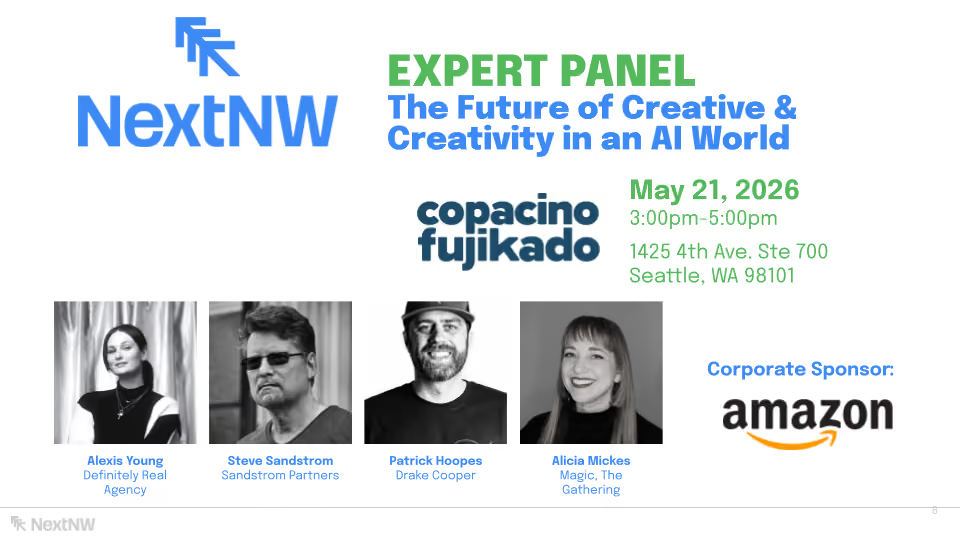
These questions will be at the center of the upcoming NextNW panel, “Future of Creative & Creativity in a Post AI-World.” The discussion brings together four accomplished creative leaders who are shaping campaigns, brands, and storytelling across agencies and global entertainment properties.
Meet the Panel
Steve Sandstrom: Executive Creative Director, Sandstrom Partners
Steve has built a reputation for developing brand platforms and campaigns that blend strategic insight with bold creative thinking. His work spans decades of agency leadership and brand storytelling.
Alexis Young: Partner and Creative Director, Definitely Real
Alexis brings a modern creative perspective rooted in design, digital storytelling, and brand development for emerging and established companies alike.
Patrick Hoopes: Executive Creative Director, Drake Cooper
Patrick leads creative at one of the Northwest’s most respected independent agencies, known for work that connects brands with culture and community.
Alicia Mickes: Senior Creative Director, Magic: The Gathering
Alicia oversees creative direction for one of the world’s most iconic fantasy brands, balancing storytelling, art direction, and fan expectations across a global audience.
Together, these creative leaders will explore how the industry is adapting to rapid technological change while protecting the craft of original thinking.
Five Questions We’ll Explore
To kick off the conversation, we asked our panelists to reflect on a few questions that many creatives are already debating in studios, Slack channels, and industry forums:
1.What does “brilliant creative” actually mean today? In a world where tools can produce visuals, copy, and concepts in seconds, how should agencies and brands define great creative work?
Steve: Do the tools actually create? Or do they generate? Should we determine whether a concept is created or generated? I think people create. Not sure about the tools yet. The healthy mind can only create from what it knows, so in some ways, we create from our abilities to access our experiences–our database so to speak–and our ability to apply or organize these things in unusual or interesting and fresh ways to solve a problem. A friend once said we’re as creative and brilliant as how hidden or obscure our references are. But I digress.... In any case, I think the evaluation is still the same. Does the work evoke an emotional response? Does it inspire, entertain, or pollute? Is it a gift, or litter? Does it seem original in its approach and execution? Do we appreciate the disruption? Is it newsworthy, or does it create opportunities for PR?
Alexis: Emotional impact is still the primary metric for brilliance, no matter how visually stunning something is. If it doesn’t move you (to joy, anger, sadness, frustration) then it has no long-term relevance and you’re just contributing to the noise.
Patrick: Great work still comes down to emotional resonance: Did it make me react on a human level? Did it make me feel a desired way about the brand/product/thing? Was it unexpectedly interesting? If so, it’s brilliant creative. And if technology helps us get there quicker and/or more easily, even better. We as an industry have always ben quick to adopt tools and tech that facilitate our expression. Today is no different, but it’s also no different that the quality of the work is still defined by its impact.
Alicia: I’d like to note my answers to these questions are 100% my opinion and should in no way be attributed to Wizards of the Coast or Magic: The Gathering.
If I had to distill it down, I believe brilliant creative should move you emotionally and originate from a human source. And while that may sound open-ended, it has to be, because creative intent and outcomes vary so widely. What defines brilliant creative is constantly evolving; shaped by shifting needs, goals, aesthetics, and cultural context. I think part of what the creative industry finds challenging about trying to define how AI (and really any emerging technology) is used in our development processes is how easily the human element can get buried beneath the tools that helped create the work. The real question isn’t whether you’re using AI–it’s how. Are you using it to amplify an original idea rooted in your own thinking? To explore and push concepts further? Or are you outsourcing the idea entirely? As we move deeper into an AI-shaped landscape, the industry will likely continue struggling to define “brilliant” in fixed terms. What’s true today won’t hold tomorrow and maybe that’s the point? Great creative resists being locked into a single definition.
2. How is the creative process changing inside agencies and brand teams? Are AI tools accelerating ideation, or are they changing how teams collaborate and refine ideas?
Steve: Currently, most of our use of AI is for product concept renderings. And one of our designers used AI to build an app for creating renderings of custom bottles we design. Not a perfect tool, but great for quick prototyping. We can load in a sketch and then input features and select from a menu of prompts, such as glass color, liquid color, closure materials, etc. To build even more detailed and realistic renderings for client presentations, we can use different AI programs in combination with 3D modeling and Photoshop. This can also better inform the glass manufacturers of our intent. Development of custom packaging can take several months and global resources. Renderings can help with the development of sales and marketing materials and investor presentations while the final product and packaging production is in the works. Our first use of AI was for The Reverend Sour Mash Whiskey label. We wrote the Reverend’s life story and then used ChatGPT to convert it into St. James bible verse. The label looked like a page out of a vintage bible and the Reverend’s story printed as old world text gives it a sense of humor.
Alexis: Our policy is that nothing ever leaves our office without human touch, so anything that is created in collaboration with AI needs to be edited, refined, and/or reproduced by a human. It’s been helpful to take ideas further, or to use as a thought-starter. The most meaningful creative way we’ve found to use it is either extending an existing asset suite to be used as secondary assets (email, PDP, etc) or for 3D renders and mockups. I wouldn’t say it’s impacting collaboration for us just yet, people have been mostly using it individually and then collaborating from there.
Patrick: I’d say AI is augmenting ideation. Using it to gain more understanding of an audience, to gather quicker and deeper research, to help see a brief from different perspective—all have become part of the creative process. And of course it’s definitely providing (and maybe even mandating) more fidelity in visual concepting and presentations. The ability to create hyper-specific versions of what we’re pitching has been a universal game-changer in the industry. As far as changing collaboration and refinement, for us that still relies heavily on the human component. AI is another voice in the room, but we still consider ourselves experts as well…
Alicia: Magic: The Gathering has had an AI policy in place since 2023. You can read a short announcement about our brand’s stance and how it’s evolved Here. Here. And here. Our creative and leadership at Magic recognized early on the importance of having a clear, thoughtful stance on how and whether generative AI should be used in creating the game we love. The stance is simple: Magic doesn't use generative AI in our final TCG product, and we require any creatives contributing to the game to not use it either. If you’ve spent time playing or collecting Magic, you know how special the game is. The soul of the game comes from the brilliant human creatives who have shaped it and we believe that’s why the game resonates so much with our audience. Magic is unlike any other trading card game in that we commission thousands of pieces of art every year for use on our cards and in our marketing, and we’re proud to support the global creative community in this way. Our fans have come to expect nothing less than exceptional work from top creative minds around the world. And as a brand, we’d be foolish not to listen.
3. Where does human creativity still have an advantage? What parts of storytelling, strategy, and cultural insight remain uniquely human?
Steve: Aesthetics. Voice. Curiosity. Dreams. Quirks. Evidence of the hand. Keep in mind that people are emotional first, intellectual second.
Alexis: Taste is the one thing that AI cannot generate, as it’s deeply personal and intangible. You can recreate a vibe using moodboards, but you cannot replicate taste and good judgement. That and tactile, print-like creative. I think we’re going to be seeing a resurgence towards more print and other hand-done aesthetics even more than we already are now.
Patrick: It’s the one percent. How many “inspirational” athletic or automotive ads/campaigns have we seen that all feel similar and formulaic, only to be blown away by one that just has that little something magical (I’m looking at you, Nike and Volkswagen)? How many schlocky, unfunny attempts at humor have we groaned at, only to be struck by the genuine wit of a brand that does it well? It’s that discovery of what we didn’t know we’d love yet—whether it be poignance, humor, aesthetic, or something else—that elevates work the little bit above the crowd it needs to stand out. And so far, only human creativity has that ability.
Alicia: Our advantage lies in the fact that humans have lived experiences. You can’t teach machines the full range of the wild, unique, and shared moments that shape us. Sure, there are patterns (that’s why psychology exists) that can be learned, but life itself is constantly surprising us. Almost every day, I come across something new humans have created and feel a sense of awe. It’s a reminder that human ingenuity is still unfolding and fully capable of unique brilliance.
Pair that with my personal philosophy that the best creative comes from a collaborative, iterative process driven by people who are open and trust one another. That shared experience of strategically building ideas together is our real advantage. Not one person working in isolation. And definitely not by one person mining for unique ideas via a chatbot.
4. How should creative leaders guide teams through this shift? What skills should the next generation of designers, writers, and art directors focus on developing?
Steve: Stay curious. Know how and know why. Understand the big stuff before you sweat the details. Earn trust. People don’t care what you know until they know that you care. Clients are more moved by the belief that you care than they are by your creative solutions. AI is a powerful and potentially scary tool that will eliminate some jobs. I’ve lived through technological shifts that ended entire professions such as typesetting, photo retouching, multiple positions within commercial printing and the number of printers as well. It threatens photographers, illustrators, writers, researchers and the like. It might also elevate those who are the most gifted. We are often in the service of creating business for clients who likely are making things the world doesn’t need more of. At its best, our work can become a part of culture. But usually it’s nothing truly sacred, except to us. If we want to thrive as part of the economic engine, we will need to continue to surprise and delight. If AI can help with that, we should figure out how best we can responsibly use it.
Alexis: Think of AI as a member of your team who knows everything, but has zero context. It’s not going away, so the more you can integrate it as an integral part of your workflow in a way that elevates your ideas and creative vs replacing it, the less afraid you’ll feel about it taking away opportunities from you. If you’re only making visuals without any strategy behind it, then you might be at risk. However, approaching the shift from more of an abundance mindset than scarcity, I think there will be far more opportunities to save us time and hopefully get us back to doing things that actually fill our cup to be better creatives.
Patrick: I don’t think we should look at it as a shift, I think we should look at it as a broadening. There are even more ways to get to great work now. We need to be working them into our skillsets and workflows. Basic AI prompting should be as foundational as navigating the internet or searching for stock photos. Remembering that AI comes in the form of tools, and tools are best used in combination with other tools, means not abandoning our current processes and technology (yet), but working these new tools into them and allowing them to make us better, faster, and smarter. It goes without saying that leaders must embrace, not resist, but we also must make it our responsibility to avoid frantic, scattershot, “because it’s there” adoption and find the best use/value for AI and focus training and integration on those areas.
Alicia: Encourage ongoing education. Learn how to use AI. Share what you know and what you’re learning. Don’t be afraid of new tools. Whether you like it or not, the industry is evolving and you need to understand what’s happening.
Understanding doesn’t mean you have to support or use these tools in your creative development. It simply gives you the context to make informed decisions, have stronger opinions, and lead with clarity.
5. Will AI raise the bar for creative work or flood the market with more noise? And how can brands ensure their work still stands out?
Steve: I think the bar has been high since the 60s. New tech is always awkward at first, so I’ll say it will probably flood the market.
Clients should not rely on fake science to determine decisions. Research, statistics and data can be helpful, and also highly suspect. The world is changing as the case study is being written. Avoid mass appeal over distinction. Don’t be average. It’s the middle. The middle isn’t safe. It’s a cemetary. It will likely become even more important for a brand to express its humanity and heart, to care and build trust.
Alexis: It’s already contributing to unskilled people leveraging the tools to vomit out slop with no plan. To make the work stand out, it needs to be rooted in genuine feeling and emotion, it needs to know what it’s SAYING.
Alicia: Oh! The market, especially social media, is already flooded with noise. No one’s immune to it, and there’s no opting out. Even if you’re not using AI directly, it’s already embedded in the tools and platforms we rely on every day. Which brings us full circle: we all benefit from continuing open, honest conversations about what AI’s role in creativity actually is and what makes brilliant creative. We’re doing part of that work here!
Education sharpens taste and will help people recognize what creative is truly special and what deserves to stand out. We’ve seen this pattern with every new technology: an initial surge where everyone experiments, followed by a natural leveling out. I think that’s the moment we’re in now. Over time, the work of those who’ve honed their craft will rise, because audiences will get better at spotting the difference. But just as important it’s worth mentioning that this is on all of us (past, present, and future creatives) to continue to champion each other. A strong, informed, and supportive creative community is what keeps the creative bar high.
Join the Conversation
If you care about the future of advertising, design, storytelling, and brand building, this is a conversation you will not want to miss. Join NextNW this May for “Future of Creative & Creativity in a Post AI-World.”

Stay connected with NextNW
Get insights delivered straight to your inbox every month or learn more about becoming a member!