.avif)
Beyond the Like: Building Social Content That Drives Results
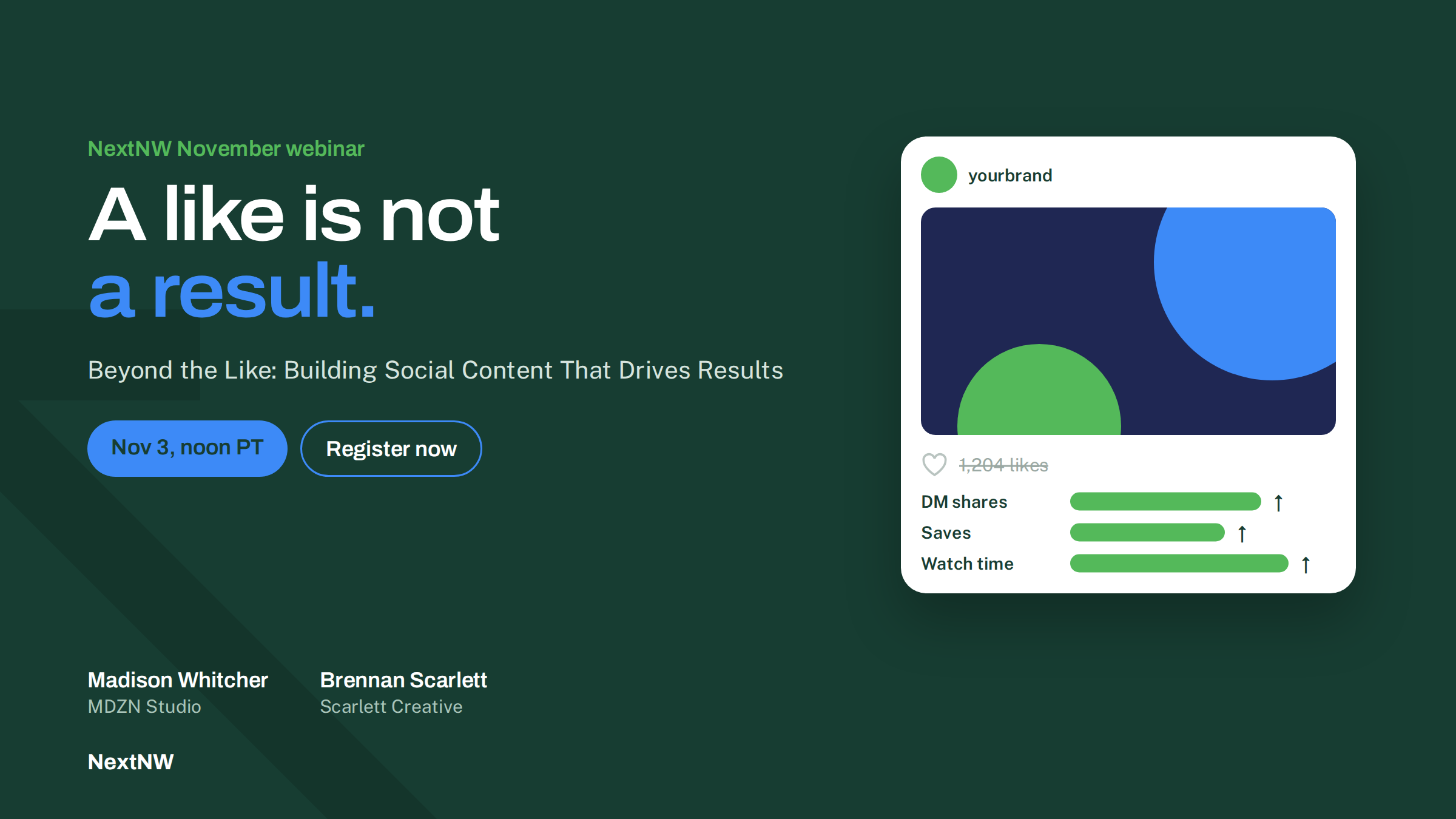
Scroll behavior has changed. Attention is shorter. Expectations are higher. And for brands, the pressure to create social content that does more than earn a like has never been greater. At NextNW, we hear it often from members across agencies and in-house teams. Social content is easier to produce than ever, but harder to make effective. The gap between activity and impact continues to widen. That is exactly what we plan to tackle in our upcoming November webinar, “Beyond the Like: Building Social Content That Drives Results.”
This session brings together two practitioners who approach social from different but complementary angles: one grounded in performance and analytics, the other rooted in storytelling, authenticity, and audience connection.
Meet the Speakers
Together, Madison and Brennan will share practical frameworks, real-world examples, and candid insights on what is working right now across platforms.
Madison brings a sharp, data-driven perspective to social strategy through her work at MDZN Studio. She focuses on how content is planned, optimized, and measured, helping brands move beyond vanity metrics to campaigns that drive real business outcomes.
Through Scarlett Creative, Brennan has built a reputation for crafting authentic digital presences, particularly for professional athletes. His work highlights the importance of voice, trust, and storytelling in a crowded social landscape.
Five Questions We’ll Explore
To set the stage for the conversation, we asked our speakers to weigh in on a few questions that are top-of-mind for marketers, creators, and brand leaders:
- What separates content that performs from content that simply fills the feed?
With so much volume, what signals actually drive engagement and conversion?
- Madison: It varies by account, and that's why regularly reviewing your analytics is so necessary. What resonates with one audience may completely miss another. But one pattern we consistently see across brands is that content with people in it performs better. People don't follow brands on social to be sold to or informed. They follow to connect. They want to know who's behind the brand, the faces, the personalities, what a real day looks like for the team working behind the scenes. Social media is at its core a human-to-human channel. The platforms were built for that kind of connection, so it only makes sense that audiences gravitate toward content that delivers it.
- Brennan: Content that actually performs offers a real value exchange. Feed-filler just talks at people to check a box.
We don't measure engagement with easily manipulated vanity metrics like likes anymore. The real vibe we’re looking for are the resonation metrics that reflect connection. The strongest signals of connection are direct DM shares, saves for later, and deep watch-time retention.
When the audience comes to your content to figure out what they should feel, laugh at, learn, or buy – that’s when you’ve unlocked real value. You aren't just posting anymore; you've become a thought partner.
- How should brands balance data and creativity in social strategy?
When should performance metrics guide decisions, and when should instinct lead?
- Madison: Data should always be the starting point. Look at what's working and what isn't, then take the loose ideas or content types from your top performers and reimagine new things within those categories. That's where creativity has the most room to run, because it's already rooted in something proven. That said, it's also important to try new things. Sometimes the content that ends up connecting with your audience is just something you haven't tested yet. Leaving space for experimentation is part of a healthy strategy. And if you don't have enough data to pull from yet, look at competitors or similar accounts in your space. Use them as a starting point to build from, then let your own analytics take over from there.
- Brennan: Data must inform your baseline strategy, but unbridled creativity is what drives a breakout moment.
- You should rely on performance metrics to optimize the packaging – like hook placement, duration, and thumbnail design. But trust your instinct to innovate.
- You simply cannot A/B test your way to a culture-defining moment; you have to take a creative leap and use the data later to measure the landing.
- What role does authenticity play in building trust and long-term audience growth?
Especially for brands versus individuals like athletes or creators.
- Madison: Authenticity is the core of everything. It's the reason people follow you in the first place, whether you're a brand, an athlete, or a creator. When that foundation starts to shift, audiences notice. Content that feels off-brand or inconsistent stops connecting, and trust is hard to rebuild once it's lost.
- Brennan: Authenticity is the ultimate currency for long-term growth because modern audiences instantly detect performative, corporate marketing.
- For individual creators, authenticity often requires raw vulnerability.
- For brands, it is rooted in transparency, consistency, self-awareness, and real investment into a community of human beings – and consistently showing up for that community.
- Brands win trust by stripping away the polished corporate veneer, owning their mistakes, and letting real human expertise drive the conversation.
- How are platform differences shaping content strategy today?
What works on TikTok, Instagram, LinkedIn, and emerging channels, and how should brands adapt?
- Madison: The obvious one is post format. Content needs to look and feel native to each platform, what works on TikTok is going to fall flat on LinkedIn and vice versa. But the bigger conversation is about where brands are actually spending their energy. There's a tendency to chase every hot new platform and want to be first to it, but that usually means spreading yourself too thin and ending up with a weak presence everywhere instead of a strong one somewhere. One to three well-executed platforms will always outperform a scattered strategy across six. Start by asking where your target audience actually is. That answer should drive everything else, including which platforms deserve your time and which ones you can ignore for now.
- Brennan: The era of cross-posting the exact same asset everywhere is dead; brands must learn the native language of each specific app.
- TikTok demands raw, narrative-driven entertainment.
- Instagram requires high-quality visual storytelling.
- LinkedIn thrives on actionable insights and contrarian takes.
To adapt effectively, adopt a "pillar content" strategy where a strong core narrative is uniquely edited and re-contextualized to fit the nuances of each platform. **this can create a foundational infrastructure that will empower an efficient and repeatable system**
- Which tools and workflows are proving most effective for planning, testing, and optimizing content?
And where are teams wasting time or overcomplicating the process?
- Madison: A solid content calendar is the foundation of any organized strategy. It keeps content planned, approvals clean, and everyone on the same page. There are a lot of great tools out there for this. Some I've used and would recommend include HeyOrca, Hootsuite, Sprout Social, Later, and Planoly. Teams tend to overcomplicate it, but investing in the right tool is absolutely worth it. The alternative is a long email thread, a shared spreadsheet that nobody's sure is current, and then trying to manually copy all of it into actual posts. The right platform eliminates that entire headache and gives your team time back to focus on the creative work.
- Brennan: When it comes to workflows, we prioritize extreme agility over perfection – pairing centralized planning hubs with rapid, platform-native editing. The biggest bottleneck in the industry right now is multi-layered approval processes that kill a trend before it ever goes live. We have to stop over-producing low-stakes content. Instead, empower your social team to shoot quickly on a phone and react to culture in real-time. To keep things moving fast, our core stack usually includes Notion, a highly organized shared GDrive, Frame.io, Slack, and Canva.
As you can see from the Q&A above, you can expect practical takeaways you can apply immediately, whether you are managing a brand account, supporting clients, or building your own presence.
Join Us in November
If your goal is to create social content that not only captures attention but drives measurable results, this session is for you. We hope to see you November 3 at noon PT for “Beyond the Like: Building Social Content That Drives Results.”

Stay connected with NextNW
Get insights delivered straight to your inbox every month or learn more about becoming a member!