.avif)
Beyond Keywords: The New Rules of SEO for Search Engines and AI Platform
Search engine optimization has changed dramatically over the past three decades. What began as a discipline focused largely on keywords and links has evolved into a much broader practice that touches content strategy, technical infrastructure, digital PR, and now AI-driven discovery.
Today’s marketers must think beyond traditional rankings. Search engines increasingly rely on entities, knowledge graphs, structured data, and credibility signals from across the web. At the same time, large language models and AI search experiences are reshaping how people discover information.
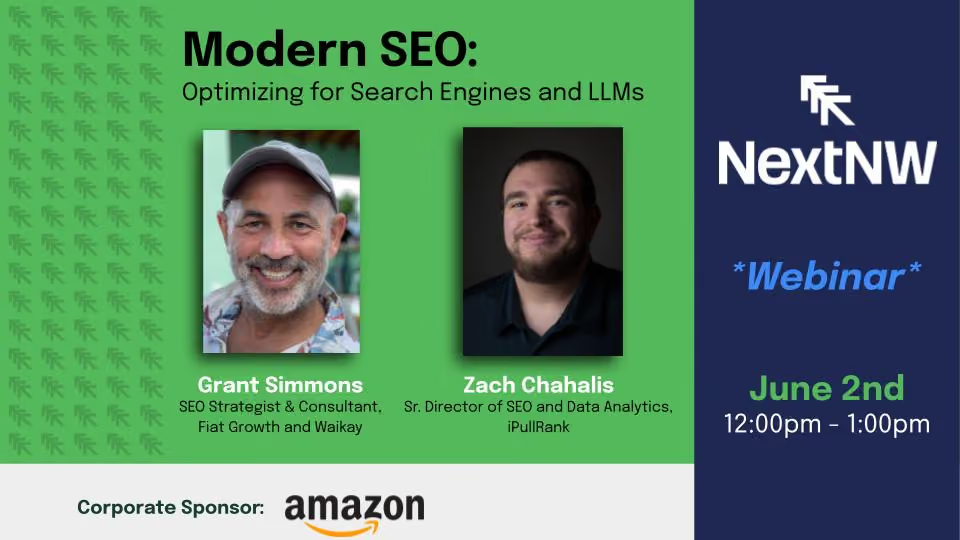
To help unpack this shift, NextNW is hosting a June webinar titled “Modern SEO: Optimizing for Search Engines and LLMs.” The session will explore how SEO fundamentals still matter while also addressing the emerging practices often referred to as AEO (Answer Engine Optimization) and GEO (Generative Engine Optimization).
The conversation will be guided by the Three C’s of SEO: Content, Code, and Credibility, a framework that highlights the key ingredients of sustainable visibility in search.
Meet the Presenters
Grant Simmons is an SEO strategist and consultant at Fiat Growth & Waikay with decades of experience helping organizations navigate complex search ecosystems. Grant will focus on the technical foundations of modern SEO, including structured data, schema, SameAs entities, internal linking strategies, and how websites can build stronger connections within knowledge graphs.
Zach Chahalis, Senior Director of SEO and Data Analytics at iPullRank, will explore the role of content and credibility signals in today’s search environment. His perspective will highlight how omnimedia content, digital PR, and brand authority influence search visibility across both traditional engines and AI-driven discovery platforms.
Five Questions We’ll Explore
To frame the conversation, we’ll ask the presenters to address several questions that are top of mind for marketing and creative professionals today:
- How has the role of SEO changed as search engines shift toward entities, knowledge graphs, and AI-generated answers?
Grant: Since Google's Hummingbird algorithm with the catchy mantra of “Things, Not Strings” (over 12 years ago), SEO’s have needed to think more about meaning than keywords. It’s not a transition that everyone has made, which often leaves large gaps between your content’s intent and what a search engine can actually understand about your content. We can reinforce meaning through entity inclusion, semantic page structure, connections to knowledge graphs, and the construction of our own graphs to reinforce topical expertise.
- What does “credibility” mean in modern SEO, and how do digital PR and omnimedia strategies influence visibility?
Grant: Simplifying. Online credibility is built through consensus, trust signals, affinity, and a recognition of topical focus. So it’s more than just “domain authority” (a metric SEO toolmakers created), it’s about credibility around a set of topics, a recognition of topical authority through citations, mentions, links, anchor text, and social signals filtered through a lens of topical relevance.
Digital PR (when done right) can help with recognition and relevance signals that convey “this is the trusted expert on this topic.”
- How important are technical factors such as schema, SameAs relationships, and internal linking in helping search engines understand a brand or organization?
Grant: Google can fumble its way to understand almost any site’s key topics, but if we want to achieve clarity, disambiguate, and make this understanding less of a fumble and more of a touchdown schema (including SameAs) and internal linking to reinforce meaning through connections to external and creation of internal knowledge graphs. These make it much easier to understand who a brand or organization is and what they do. Context is King!
- What are the key differences between traditional SEO and emerging approaches like AEO or GEO?
Grant: Core tactics. Clarity. Disambiguation. Simplicity. Directness. These are all elements SEOs should be aware of and look through a slightly different lens when creating and organizing content. Citations on authoritative or seed sites are key to discovery and initial visibility, but being citation-ready vs. citation-worthy is probably the biggest disconnect from traditional SEO, which is more about being crawl-ready. There’s overlap, but ultimately having an understanding of *why* LLMs should cite you as a resource is as important as knowing *how* LLMs cite content. Content needs to be better and more unique, for sure… but it’s also about giving answers and leaving some breadcrumbs for a click-worthy experience within the cited site, if you want to get folks from answers to your site experience.
- What practical steps should marketing teams take today to prepare their websites and content for the future of AI-assisted search?
Grant: Review marketing copy that generally dominates page headers and replace/augment with clarity and directness. Stating what you do simply and unambiguously is one of the first things marketing teams should address. It doesn’t mean tearing a website down to its bones, but it does mean putting on your “LLMs are quite dumb” hat and trying to explain products and services clearly. Marketing teams should then take a deep look at their site’s content and ask (brutally), “Does this page add value to the web?” If not, consider how it can be improved, augmented with unique data, owned experiences, or expert knowledge or advice. Read EEAT guidelines and review all content through that lens.
These questions reflect the real challenges many marketing teams are facing. The goal of the session is to move beyond theory and provide practical guidance that agencies, brands, and independent professionals can apply immediately.
Why This Conversation Matters
For the NextNW community of advertising, marketing, creative, and digital professionals, SEO is no longer just a channel. It is a foundational layer that connects content, technology, public relations, and brand credibility across the entire digital ecosystem.
Understanding how search engines and AI systems interpret content can influence everything from website architecture to media strategy.
This webinar is designed to help marketers step back, understand how the landscape has evolved, and identify the opportunities that lie ahead.
Join Us
If your work touches content strategy, digital marketing, PR, or website development, this conversation will provide valuable insights into how search visibility is evolving. Register now for the NextNW webinar “Modern SEO: Optimizing for Search Engines and LLMs” this June and join us for an engaging discussion with Grant Simmons and Zach Chahalis. We look forward to seeing you there.

Stay connected with NextNW
Get insights delivered straight to your inbox every month or learn more about becoming a member!